
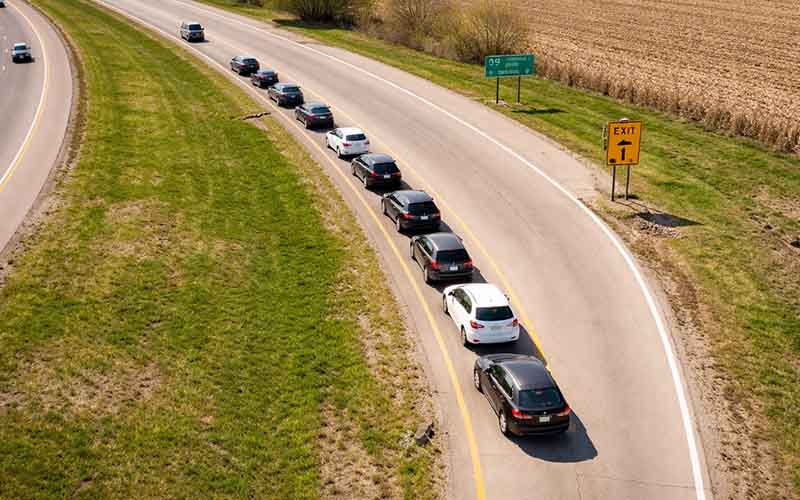
On major football weekends, a quiet stretch of highway outside Council Bluffs, Iowa, transforms into something unexpected. Cars pull onto the shoulder, engines idling, drivers staring at their phones. There are no businesses, no rest stops, no attractions, yet the location draws hundreds of Nebraska residents during the NFL season.
The reason has nothing to do with car trouble. It has everything to do with sports betting laws.
Online sports betting in Nebraska is prohibited, but Iowa allows it. That legal gap has turned the state line into a digital checkpoint, forcing bettors to physically cross into Iowa just long enough to place a wager.
Betting by GPS, Not by Choice
Modern sportsbooks rely on geolocation software to verify where a bet is placed. If the phone is in Nebraska, the bet is blocked. Cross into Iowa, and the app suddenly works.
Data from geolocation firm GeoComply shows how extreme this workaround has become. During the 2025 football season, hundreds of thousands of location checks were recorded near a single Iowa exit ramp just over the Nebraska border. At times, dozens of cars were logged in the same small area, all for the same purpose.
This phenomenon highlights a growing disconnect between how gambling laws are written and how technology allows people to navigate around them.
The Push to Legalize
Casino operators and national sportsbook companies are now backing an effort to legalize online sports betting in Nebraska through a ballot initiative. Supporters argue the state is leaving significant tax revenue on the table, while neighboring Iowa benefits from Nebraska residents crossing the border to bet.
They also point out that voters already approved casino gambling and question why mobile sports betting remains off-limits.
Opponents take a very different view. Advocacy groups warn that legalizing online betting would increase addiction, normalize gambling for younger audiences, and create long-term financial harm. From this perspective, Nebraska’s restrictions are not outdated, they’re protective.
The Option Few Are Talking About: Offshore Sportsbooks
Lost in much of the debate is a key reality: many bettors never make the drive to Iowa.
Offshore sportsbooks, operating outside US jurisdiction, allow users to place bets online without relying on domestic geolocation systems. These platforms accept players within Nebraska, making them an appealing alternative for locals who don’t want to cross state lines or wait for legal changes.
For some, offshore betting has quietly replaced border hopping altogether. That means a portion of betting dollars may already be leaving the region entirely, not flowing into Iowa or Nebraska, but overseas.
This raises an uncomfortable question for policymakers: Does banning online sports betting actually limit gambling, or does it simply push it beyond state oversight?