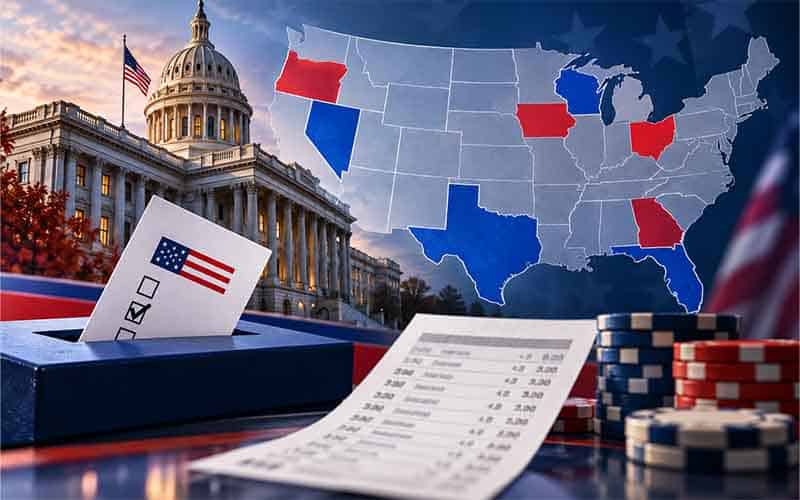
With Election Day approaching on November 3, the 2026 gubernatorial elections are drawing increasing attention as Republicans and Democrats compete for control of state governments across the country. 36 governorships are up for grabs, with several races showing close polling, heavy campaign spending, and major disagreements over taxes, healthcare, immigration, and economic policy.
Political betting sites are also attracting attention, particularly in Georgia, Nevada, Ohio, and other states where the results remain the subject of considerable debate. Offshore bookmaker BetUS has released election odds for numerous gubernatorial contests, offering a snapshot of how its markets are pricing the candidates ahead of the vote.
While some states have longstanding partisan advantages, others feature unusually competitive elections that could influence the political landscape well beyond 2026.
What Are the Latest 2026 Governor Election Betting Odds?
BetUS provided the following lines on October 21, 2026, for eight gubernatorial contests attracting attention because of competitive markets, polling developments, or significant political implications.
| State | Republican candidate | Democratic candidate |
|---|---|---|
| Georgia | Rick Jackson (-135) | Keisha Lance Bottoms (-105) |
| Nevada | Joe Lombardo (-120) | Aaron Ford (-120) |
| Ohio | Vivek Ramaswamy (+200) | Amy Acton (-300) |
| Oregon | Christine Drazan (+200) | Tina Kotek (-300) |
| Texas | Greg Abbott (-400) | Gina Hinojosa (+250) |
| Florida | Byron Donalds (-500) | David Jolly (+300) |
| Wisconsin | Tom Tiffany (+300) | David Crowley (-500) |
| Iowa | Zach Lahn (+550) | Rob Sand (-1000) |
These political prop bets reflect sportsbook markets, not election forecasts or polling results. They can change with new information, campaign developments, and betting activity, and include the bookmaker’s margin.
Georgia: Rick Jackson vs. Keisha Lance Bottoms
Georgia features a contest between Republican healthcare executive Rick Jackson and former Atlanta Mayor Keisha Lance Bottoms, a Democrat. Republican Governor Brian Kemp cannot seek another consecutive term, creating an open-seat election in a state that has become nationally competitive.
Healthcare access, taxes, and affordability have dominated the campaign. Bottoms supports full Medicaid expansion and targeted tax relief, while Jackson advocates income and property tax reductions, healthcare cost reforms, and a different approach to expanding medical coverage. A University of Georgia survey conducted October 7–15 found Jackson at 46% and Bottoms at 45% among 1,000 likely voters, within the poll’s margin of error.
Nevada: Joe Lombardo vs. Aaron Ford
Nevada’s election pits incumbent Republican Governor Joe Lombardo against Democratic Attorney General Aaron Ford. The contest is particularly notable because Nevada has demonstrated a willingness to elect statewide candidates from both major parties.
Economic concerns, public safety, education, and housing affordability are important campaign issues. The election also includes independent candidate Danielle Ford, whose shared surname with the Democratic nominee has generated discussion about potential voter confusion. An October survey by Global Strategy Group measured Lombardo at 48% and Aaron Ford at 47% among 700 likely voters, illustrating how closely divided the electorate remains.
Ohio: Vivek Ramaswamy vs. Amy Acton
Ohio’s gubernatorial election has attracted national attention because of the candidates’ backgrounds and increasingly contentious campaigns. Republican Vivek Ramaswamy is a biotechnology entrepreneur and former presidential candidate, while Democrat Amy Acton previously served as Ohio’s public health director during the COVID-19 pandemic.
Ramaswamy has emphasized deregulation, property tax relief, and changes to public education, while Acton has focused on healthcare, affordability, and public services. The campaign intensified in October after a controversial advertisement featuring Acton’s estranged mother drew criticism from members of both parties. An October 13–18 Marist survey of 1,176 likely voters reported Acton at 50% and Ramaswamy at 43%, although other surveys have produced different results.
Oregon: Tina Kotek vs. Christine Drazan
Oregon Governor Tina Kotek is seeking another term against Republican Christine Drazan in a rematch of their 2022 contest. Despite Oregon’s Democratic voting history in presidential elections, its gubernatorial elections have sometimes been considerably more competitive.
Homelessness, housing construction, education, and behavioral healthcare have become central issues. Kotek entered office promising substantial improvements in these areas, while Drazan has criticized the administration’s progress and emphasized the cost of living. The campaign has focused heavily on whether state government has delivered measurable results on problems affecting communities across Oregon.
Texas: Greg Abbott vs. Gina Hinojosa
Republican Governor Greg Abbott is seeking a fourth term against Democratic state Representative Gina Hinojosa. Texas has not elected a Democratic governor since Ann Richards in 1990, making the contest significant for a state with a long record of Republican statewide victories.
Hinojosa has emphasized household expenses, property taxes, and concerns about economic development incentives, while Abbott has defended his administration’s business policies and broader governing record. The expansion of large technology facilities and their impact on local communities has also entered the campaign. Recent reporting has described a narrowing contest, with some surveys showing little separation between the candidates.
Florida: Byron Donalds vs. David Jolly
The open-seat election in Florida pits Republican Congressman Byron Donalds against former Republican Congressman David Jolly, now a Democrat. The winner will succeed Governor Ron DeSantis, who is completing his second consecutive term.
Housing costs, property insurance, healthcare expenses, and affordability have become significant campaign subjects. Jolly has emphasized the financial challenges facing Florida households, while Donalds has raised substantially more campaign money. The Cook Political Report recently changed its assessment of the contest from likely Republican to lean Republican, reflecting a more competitive race than earlier expectations suggested.
Wisconsin: Tom Tiffany vs. David Crowley
Wisconsin’s contest between Republican Congressman Tom Tiffany and Milwaukee County Executive David Crowley is another closely watched open-seat election. Democratic Governor Tony Evers is not seeking reelection, leaving voters to select a successor in a state known for narrow statewide election results.
The campaigns have addressed public safety, immigration, economic costs, and the influence of national political figures. Tiffany has substantial backing from Republican donors, while Crowley has received support from prominent Democrats, including Evers. An October Associated Press report described a recent Marquette University poll showing a dead heat, underscoring the importance of turnout across Wisconsin’s urban, suburban, and rural communities.
Iowa: Rob Sand vs. Zach Lahn
Iowa’s gubernatorial election pits Democratic State Auditor Rob Sand against Republican Zach Lahn after Governor Kim Reynolds decided not to seek another term. The contest has drawn attention because Iowa has supported Republican presidential candidates in recent elections while also electing Democratic governors.
Sand has campaigned on government accountability, bipartisan cooperation, healthcare, and public trust, drawing on his experience investigating fraud and public corruption. His statewide town hall campaign has emphasized direct conversations with voters. The election offers another chance to examine how economic concerns and candidates’ backgrounds shape voting behavior beyond traditional party divisions.
How Could the 2026 Governor Elections Shape State Politics?
The November 3 elections will determine leadership in 36 states, with consequences for education funding, tax policy, healthcare programs, infrastructure, and public safety. The results will also affect how governors work with state legislatures and could influence future debates over congressional redistricting.
Although election betting markets offer one perspective on these contests, they should be considered alongside public polling, candidate platforms, and developments on the campaign trail. With less than two weeks remaining before Election Day, voter turnout and the remaining campaign activity will be central to the final results.
Gubernatorial Odds Provided By BetUS (BetUS Review) | The Hill